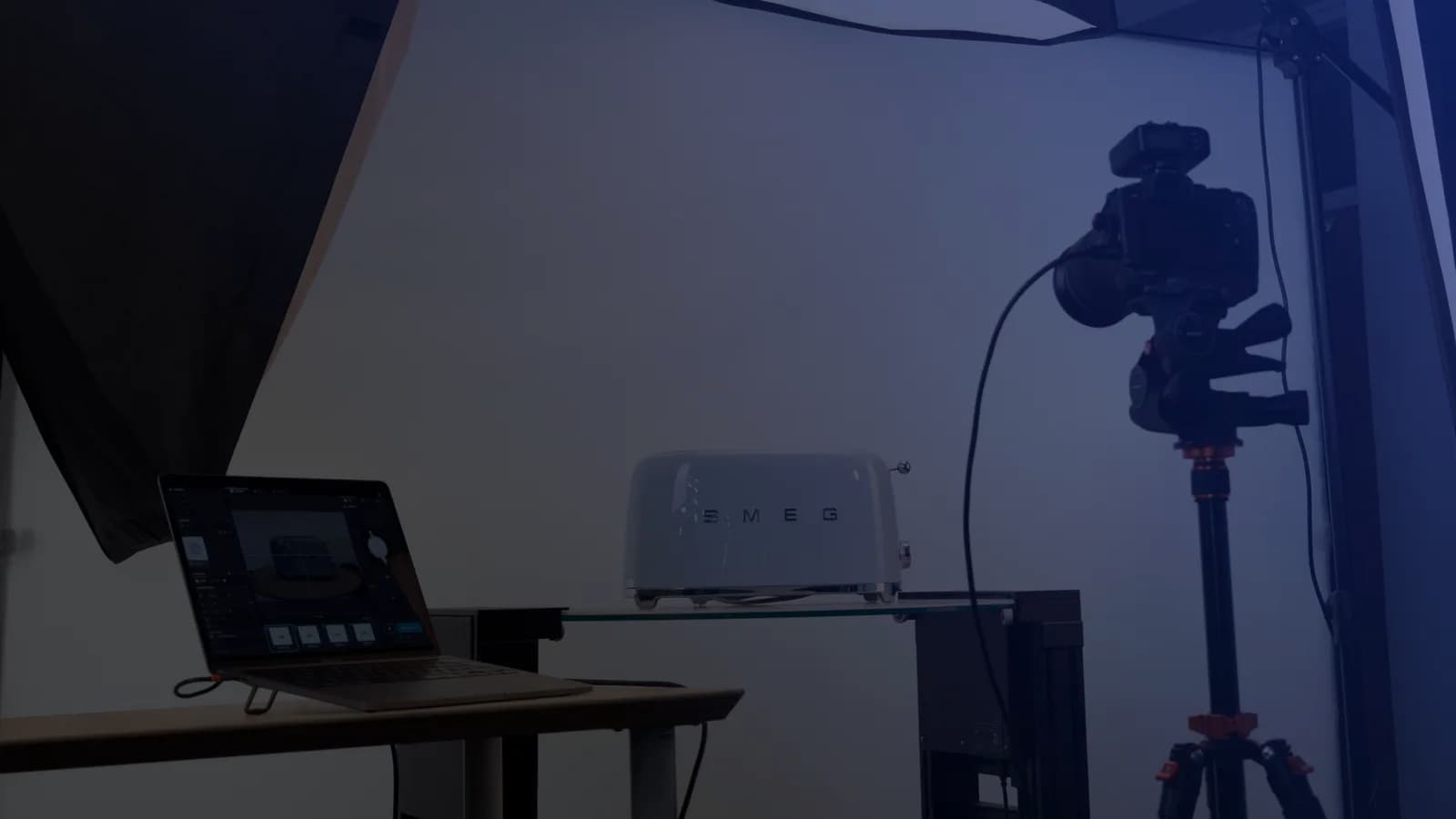
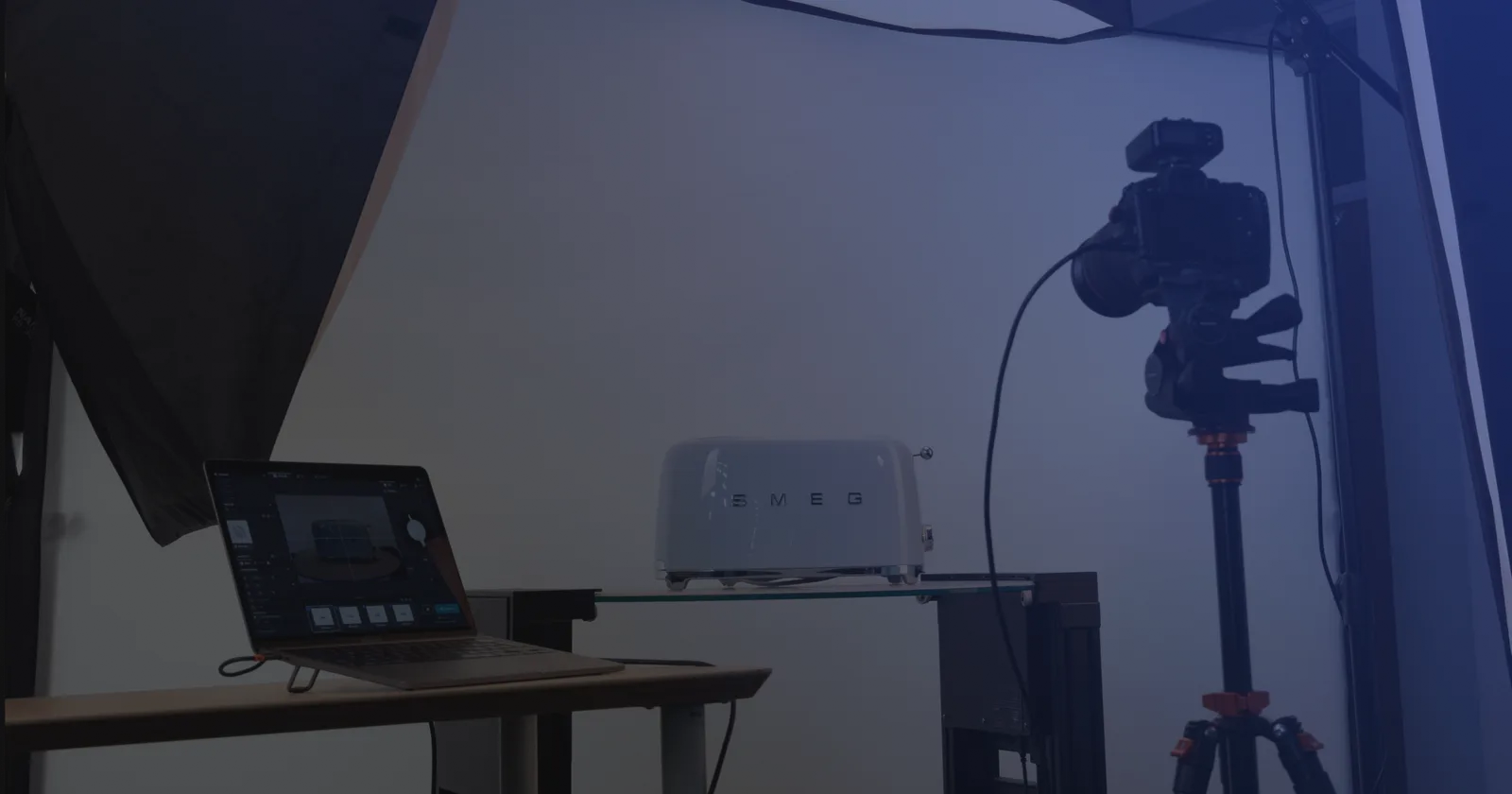
Tethering software connects your camera to a laptop, tablet, or phone so you can preview shots in real time, control the camera remotely, and get files off the card the moment they're captured. For a high-volume product photography team, that's the difference between shooting a batch and hoping it's usable, and checking every frame as it lands. No more shoot-to-card-then-review. Every image gets checked, named, and sent toward retouching the moment it's shot.
This guide walks through what tethering software actually does, how wired and wireless setups compare in 2026, which tools are worth trialing for an e-commerce studio this year, and the point where tethering alone stops scaling.
- Tethering software connects a camera to a laptop, tablet, or phone for live preview, remote shooting, and instant file transfer.
- Wired tethering (USB-C or USB 3.0) is faster and more reliable. Wireless is more flexible on location and in multi-camera setups.
- For studios shooting hundreds of SKUs a day, tethering is one part of the workflow, not the whole workflow.
- The right choice starts with what your studio actually needs the software to do - not with which camera you happen to own.
Think of tethering software as the layer between your camera and your screen. On the camera side, it speaks the camera's own language - PTP (Picture Transfer Protocol), a manufacturer API like Canon CCAPI, or an IP-based Wi-Fi connection. On the screen side, it shows you live view, hands you the camera's controls, and catches each file the instant it's captured.
What it replaces: shooting to a memory card, ejecting the card, importing to a workstation, and only then finding out what's actually in the frame. That loop is slow, and it's where mistakes hide until it's too late to fix them cheaply.
Photographers use tethering for lifestyle shots, portraits, focus stacking, on-model images, and product photography - packshots included. There's generic tethering software built for any of those, and there's product-oriented tethering software built specifically for the last one (Orbitvu Station is in that second category).
What a tethered setup gets you:
- Live view on a larger screen. You review images at full resolution as they arrive, not squinting at a camera's rear display.
- Remote shooting. Shutter, aperture, ISO, white balance, and focus, all from the computer.
- Automatic file transfer with structured naming and folder rules, no manual sorting later.
- Metadata applied on capture. IPTC fields, keywords, custom tags - written the moment the shutter fires.
- Presets, LUTs, or reference profiles applied to photos as they land.
For a working product photography team, that turns quality control from something you do after the shoot into something you do on every single shot.
Two connection methods. Two very different trade-offs.
Wired tethering uses a USB cable - most commonly USB-C or USB 3.0 - between the camera and a laptop or workstation. It's the fastest option, the most consistent, and it supports everything: live view, RAW transfer, remote shooting, video capture. The catch is physical: cables restrict movement, and length matters. A standard passive USB-C or USB 3.0 cable holds up reliably to about 3 meters, per the USB 3.0 specification. Push past that, and you need an active or repeater cable, commonly rated up to around 4.5 meters or more, to keep the signal clean.
Wireless tethering uses built-in Wi-Fi, an external transmitter, or an IP-based protocol like Canon's CCAPI. No cable, which means more freedom - a real advantage in multi-camera setups or out on location.
| Criterion | Wired | Wireless |
|---|
| Speed | Fastest, near-real-time | Slower historically; closing the gap on newer solutions |
| Reliability | High and consistent | Depends on network quality and interference |
| Mobility | Restricted by cable length | Full range within Wi-Fi coverage |
| Best use | High-volume studio, packshot lines, automated capture | Location shoots, multi-camera rigs, client-facing sessions |
Most high-volume operations standardize on wired for the studio floor, then add wireless where mobility actually matters - client review on set, mannequin sessions, location shoots.
For a portrait or wedding photographer, tethering is a quality check they run a few times a shoot. For a commercial product photography team shooting hundreds of SKUs a day, it's part of the production line - not a nice-to-have, but a load-bearing piece of the process.
Here's what matters most once you're running a high-volume e-commerce studio:
- Quality control happens per SKU, not per session. Reflections, alignment issues, missed focus - you catch them before moving to the next product, not at the end of a batch when it's too late to reshoot cheaply.
- Framing and file names stay consistent no matter who's shooting or which shift it is. Templates lock the composition; naming rules lock the file structure.
- No manual card offload. Files move from camera to disk to the retouching queue on their own.
- One trigger fires every camera at once - works for 360° spins, packshot lines, multi-angle setups, everything landing in the same folder structure.
- Metadata gets written at capture, not bolted on afterward. SKU codes, custom fields, keyword tags are already on the file, so your DAM, PIM, and marketplace feeds get labeled images from the start.
None of this matters much if you're a single shooter doing portraits. It all adds up fast once your SKU volume grows.
Once a studio is shooting hundreds of SKUs a day across multiple angles, generic tethering tools built for portrait or landscape work start showing gaps. Here's what actually matters at that volume.
Not just camera control - the whole loop from setup to publication:
- Setup: product-specific templates for camera settings and lighting, so a new SKU doesn't mean reconfiguring the studio from scratch.
- Capture: compatibility with motorized turntables, motorized rigs, and multi-camera arrays for 360° spins and multi-angle shoots, plus built-in focus stacking.
- Post-production: presets and templates applying the same treatment across a batch, with retouching tools built in - manual and AI-assisted.
- Publication: file naming tied to product SKU, custom metadata export, and integration with whatever system the images feed into next.
- Asset management: content organized around product SKU and category.
Images grouped by SKU, angle, or campaign - not by shoot date or which memory card they came off.
Apply an adjustment, a crop, or a retouch to hundreds of images at once. Not one file, one click, one at a time.
Barcode or QR scanning pulls product data straight into the file's metadata. SKU, product name, category - embedded before the shot leaves the studio.
Rich content in one workflow
Video clips, 360° spins, and still images, captured in the same session, in the same tool, tagged with the same metadata structure. Not three exports from three different systems.
Studios rarely stick with one camera body forever. The tethering layer needs to keep up with Canon, Nikon, Sony, Fujifilm, Panasonic, and whatever the studio picks up next.
- OEM manufacturer tools. Free and single-brand: Canon EOS Utility, Nikon NX Tether, Sony Imaging Edge Desktop, Fujifilm X Acquire, Panasonic LUMIX Tether. Solid for basic tethered shooting inside one ecosystem. Minimal automation, no cross-brand support.
- Third-party professional platforms. Paid, multi-brand: Capture One Pro, Adobe Lightroom Classic. Deeper RAW processing, richer live view controls, tighter post-production integration.
- One-time purchase and community tools. Smart Shooter ($99 base, plus additional per-camera licensing up to 10 cameras), Tether Studio ($99, Mac), digiCamControl (free, Windows, open-source), Helicon Remote, and gPhoto2 (free command-line tool for Linux and macOS). The answer to subscription fatigue, with narrower feature sets than Capture One.
- Mobile and specialized tools. Cascable Studio (iOS and macOS app for camera control and tethering), Honcho (event delivery), Evoto (AI editing during tether). Narrower use cases - location, delivery, or AI-first editing.
- Automation-tier platforms. Orbitvu Station and other purpose-built product photography automation software. Tethering is one component in a workflow that also handles turntables, lighting, masking, retouching, and publishing. Different scope entirely from the categories above - not just another tethering tool.
| Software | Category | Cost | Cameras supported | Standout features | Best for |
|---|
| Canon EOS Utility | OEM | Free | Canon | Live view, remote control, USB | Canon-only, basic setups |
| Nikon NX Tether | OEM | Free | Nikon | Live view, video, wireless with newer bodies | Nikon-only, basic setups |
| Sony Imaging Edge Desktop | OEM | Free | Sony | Live view, remote control | Sony-only, basic setups |
| Orbitvu Station | Automation tier | Varies per country | Canon, Sony (selected models) | Tethered capture + turntable and lighting control + AI Masking + publishing | High-volume product photography operations |
| Capture One Pro | Third-party pro | Paid subscription, tiered by plan - check current pricing at captureone.com | 650+ RAW / 200+ tethered | Deep RAW processing, ReTether, 2nd-Gen Canon wireless | Professional multi-brand studios |
| Adobe Lightroom Classic | Third-party pro | ~$20/mo Photography plan (1TB) | Canon and Nikon primarily | Catalog + editing integration | Studios centered on the Adobe pipeline |
| Smart Shooter | One-time / tiered | $99 base, plus additional per-camera licensing (up to 10 cameras) | Canon, Nikon, Sony, Fujifilm | Multi-camera sync (up to 10), scripting, QR/barcode | Multi-camera setups, scripted workflows |
| Tether Studio | One-time | $99 (Mac only) | 2,900+ claimed (vendor claim) | AI Smart Cull, art director markup | Mac shooters wanting a Capture One alternative |
| digiCamControl | Community / free | Free (Windows) | Canon, Nikon, Sony primarily | Open-source, scripting, multi-camera | Windows studios on a strict budget |
Vendor-claimed camera counts noted where relevant. Prices as of publication - verify with each vendor for current pricing.
Start with why you need it, not with what you already own. If you're photographing thousands of products, the software is what makes or breaks the operation - not the camera body, not the workstation. Both of those you can swap out next year without touching your workflow. The software is what your whole team builds their process around, and re-platforming it later is expensive. So work through this in order: purpose first, hardware second.
A studio shooting a few dozen frames a day is well served by a free OEM tool plus a general editor. That's it - don't overbuy. A studio shooting hundreds of SKUs across multiple angles needs something else entirely: multi-camera sync, barcode-based metadata, template-driven setup, scriptable batch processing. Get honest about which studio you actually are before you compare a single feature list. This decision shapes everything below it.
Check the software's supported camera list, and check it against the specific features you need: wired vs wireless, video capture, focus control, live view. Wireless support varies by camera body more than most buyers expect - Capture One's 2nd-Gen wireless, for example, works with the Canon EOS R5 Mark II and EOS R1 only. If you're still choosing bodies, our guide to product photography camera settings covers the shooting fundamentals.
Windows-only options (digiCamControl), Mac-only options (Tether Studio), or Linux tools (gPhoto2) narrow the field before feature comparison even starts.
4. Look at post-production integration
If retouching runs on Capture One sessions, Lightroom catalogs, or a DAM with specific ingest rules, the tethering tool needs to feed that pipeline without a manual export step in between.
Every paid option offers a free trial. Download it and run an actual production shoot - not a connection test. Test it under real conditions: your cables, your network, your camera's firmware version.
For studios producing 100+ SKUs a day, this checklist may only get you partway there. Tethering is one part of the workflow. The bigger question is whether every stage after capture is actually talking to every stage before it.
Try the software
Explore the possibilities of AI-driven workflow
For a team still growing into high-volume production, picking tethering software is the whole conversation. For a team already there, it's just one problem solved - a few more still need fixing.
Signs your studio has outgrown tether-only workflows:
- Retouching queues growing faster than capture output
- Framing and composition drifting between operators or shifts
- Manual QC required on every SKU because template enforcement is inconsistent
- File naming and metadata varying across shoots, then getting cleaned up downstream
- Multi-angle or 360° sessions needing separate setup steps for each product
- Handoffs between capture, retouching, and publishing done manually, or by email
At that point, the useful question isn't "which tethering software" or "what else to bolt on" - it's "which platform handles the whole loop."
Purpose-built product photography automation software like Orbitvu Station treats tethered capture as one input into an end-to-end workflow that also covers turntable and lighting control, AI Masking, retouching, and publication. The tethering itself is table stakes. The value shows up in everything that happens between the shutter and the product page.
Tethered shooting is the practice of connecting a camera to a computer, tablet, or phone during a shoot. Tethering software is the tool that makes it work. Any platform in this guide lets a photographer shoot tethered.
For runs under 3 meters, a standard USB-C or USB 3.0 data cable is fine. Beyond 3 to 4.5 meters, use an active or repeater cable rated specifically for data transfer. Cheap or overly long passive cables are one of the most common causes of a dropped tethered connection.
Yes, on cameras that support Wi-Fi or IP-based tethering. Wireless used to lag noticeably behind wired. Recent protocols like Canon CCAPI have narrowed that gap to a few seconds on supported bodies.
No. An automation platform like Orbitvu Station includes tethered capture as part of a larger workflow that also handles turntable and lighting control, AI Masking, retouching, and publication. You generally don't need a separate tethering tool on top of it.
This article was written with the assistance of AI technology.